Ending the Confusion and Chaos for Women Navigating Divorce

Save time, money, headache and heartache and get on with your life

READ OUR BLOG Watch Preview

Spin Divorce Mission:  Equipping parents with the legal strategy, procedural literacy, and court-tested tools needed to stop post-separation abuse and protect their family's future.

lesson image

Even a "normal" divorce is exhausting—shattering future plans and throwing you into a maze of legal forms, court dates, and mounting bills. But divorcing a high-conflict or narcissistic ex takes that stress to a whole new level.

To them, court isn't a place to find a fair solution—it's a game they intend to win at all costs. They weaponize the system using delay tactics, financial pressure, and litigation abuse designed to drain your energy and wallet. While courts are beginning to recognize these behaviors as coercive control, high-conflict personalities continue to exploit the gaps. You cannot fight this dynamic with hope alone—you need strategy, procedural boundaries, and a solid plan to protect yourself and your family


lesson image 

What is Post-Separation Abuse?

Post-separation abuse occurs when a high-conflict or abusive ex continues to exert power, financial control, and coercive tactics long after the relationship has ended. In family court, these behaviors are universally applied to wear you down and force unfair outcomes.

Common forms of post-separation abuse in court include:

  • Litigation Abuse & Vexatious Motions: Filing endless, meritless applications to force you into court, drain your retainer, and exhaust your emotional energy.

  • Financial Sabotage: Withholding disclosure, hiding assets, abruptly cutting off support, or draining bank accounts so you cannot afford legal representation.

  • Custody Weaponization & Counter-Parenting: Using child access and decision-making as bargaining chips, refusing to cooperate, or making false allegations to alienate the child.

  • Intimidation & Stalking: Utilizing threats, digital tracking, or harassment to maintain control outside the courtroom.

  • Distorting the Narrative: Weaponizing court forms to make false claims of alienation or abuse, turning the justice system into their personal tool of coercion.


The Bad News


The courts, WHERE ANYTHING CAN HAPPEN, are not equipped to handle the high-conflict narcissistic personality and many court professionals and judges lack education related to the damage these individuals cause…. Making the courts a costly and scary platform to engage with the abuser.

lesson image


 The Good News


Knowing the strategies, the narcissist is likely to employ, empowers the healthy parent to make choices that assist them in avoiding the pitfalls of the FAMILY COURT legal system.  


lesson image


***Disclaimer: I am not trained as a Family Lawyer and therefore I cannot give legal advice. I can offer coaching and share lessons learned that are based on my personal experience. Everyone's experience in family court and during divorce is unique and a cookie cutter approach cannot apply to the complexities of the Family Justice System. All information on this website is to be viewed from a coaching perspective. Due diligence and legal advice is the responsibility of the reader in all cases.

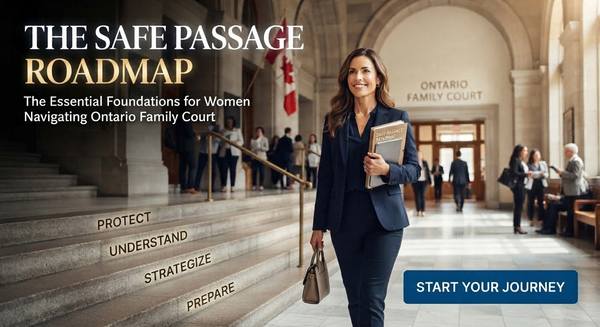
Lessons in The Safe Passage Roadmap: For Women Navigating Ontario Family Court:

  1. 1 Welcome to the Safe Passage Divorce Education for Women Roadmap

    Objective: Orient you to the Safe Passage Roadmap course and how it helps you.

  2. 2 Lesson 1: Which family court will handle my matter?

    Objective: Understanding the court that has jurisdiction over your matter.

  3. 3 Lesson 2: What region is my court in?

    Objective: Understand your court region so you can access the right information.

  4. 4 Lesson 3: What is legislation?

    Objective: Understand the core legislation in family law Ontario.

  5. 5 Lesson 4: What are the family law rules?

    Objective: Understand and locate the FLR (Family Law Rules)

  6. 6 Lesson 5: Family law forms explained

    Objective: Understand family court forms better.

  7. 7 Lesson 6: Where do I find family court forms?

    Objective: Learn where to access up-to-date family court forms.

  8. 8 Lesson 7: How is a family court case started?

    Objective: Learn how to file an application for divorce in family court.

  9. 9 Lesson 8: What are practice directions?

    Objective: Learn what practice directions are and where to find them.

  10. 10 Lesson 9: What is case law?

    Objective: Understanding caselaw and learn how judges reason.

  11. 11 Lesson 10: What is Canlii and why does it matter?

    Objective: Learn about the value of Canlii for legal research and precedent.

  12. 12 Lesson 11: How to get the most out of reading Caselaw

    Objective: Learn the importance of case law and how to apply it to your matter.

  13. 13 Lesson 12: Why caselaw matters: An example

    Objective: Learn how to evaluate a court decision's ongoing authority on CanLII and use this knowledge to further your case.

  14. 14 Lesson 13: How Does an Ontario Family Court Case Move Though The System

    Objective: Understand the Ontario Family Court roadmap and feel more confident.

  15. 15 Lesson 14: What Is a Case Conference?

    Objective: Learn the importance of the case conference and how to avoid the traps inside it.

  16. 16 Lesson 15: Why Didn't The Judge Just Decide?

    Objective: Gain insight into the nature of the first judicial appearance.

  17. 17 Lesson 16: Motions: What Are They and When Do Your Need One?

    Objective: What is a motion and what can be resolved here?

  18. 18 Lesson 17: Understanding Judicial Decisions and Court Orders

    Objective: Understand Judicial Decisions and Court Orders

  19. 19 Lesson 18: Offers to Settle and Costs: Why Strategy Matters in Family Court

    Objective: Understand the correct use of and importance of Offers to Settle

  20. 20 Lesson 19: Trial: What Happens When Your Case Goes to Trial

    Objective: The beginner lesson on the foundations of the family court trial.

  21. 21 Lesson 20: Appeals: What Happens If you Think the Judge Got It Wrong?

    Objective: Understand the criteria for a successful family court appeal.

  22. 22 You Have A Road Map: Now What?

    Objective: Appreciate the family law case foundation milestone.

About Lorraine

avatar-profile
LORRAINE LAWSON

Certified High Conflict Divorce Coach, Mother, Educator and Advocate
EMAIL: SPINDIVORCE@GMAIL.COM

Lorraine Lawson is a Certified High Conflict Divorce Coach, DV survivor, and fierce advocate dedicated to helping women navigate post-separation abuse. After spending over a decade surviving Ontario family court—and losing massive amounts of time and money before learning to successfully self-represent—she uncovered how high-conflict exes weaponize the system to win at all costs. Lorraine created Spin Divorce to give you the strategic blueprint, legal literacy, and safeguards you need to protect your children, preserve your assets, and take back control of your future..

***Disclaimer: I am not trained as a Family Lawyer and therefore I cannot give legal advice. I can offer coaching and share lessons learned that are based on my personal experience. Everyone's experience in family court and during divorce is unique and a cookie cutter approach cannot apply to the complexities of the Family Justice System. All information on this website is to be viewed from a coaching perspective. Due diligence and legal advice is the responsibility of the reader in all cases.

READ OUR BLOG